
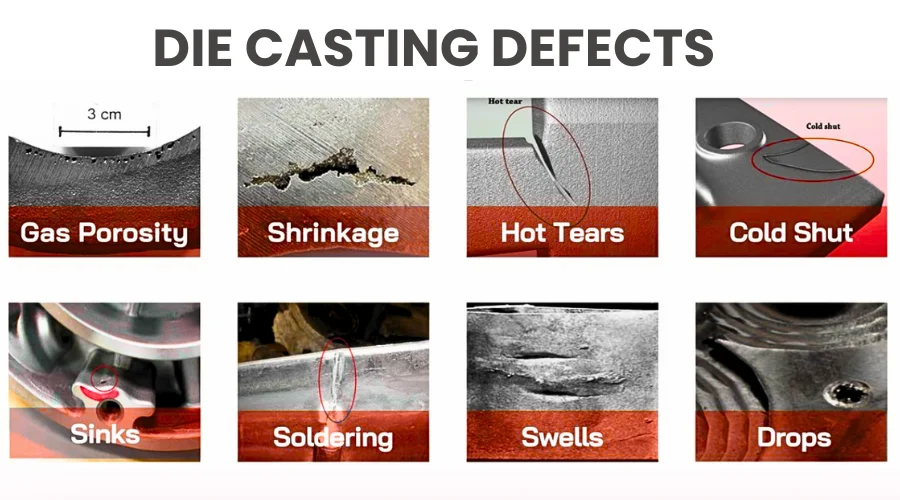
Die casting can produce complex metal components with tight dimensional requirements and repeatable quality, but casting quality depends on much more than the alloy and machine. Die design and process parameters directly influence how molten metal fills the cavity, how air escapes, and how the part solidifies.
When these factors are not considered together, common die casting defects such as porosity, cold shuts, misruns, flash, soldering, and hot cracking can appear. For production projects, correcting these issues after tooling is complete can mean additional machining, tool modification, sampling, and production delays. A better approach is to identify potential risks during design and process planning.
With capabilities covering tooling, die casting, CNC machining, quality inspection, and engineering support, HordRT integrates design review and manufacturing considerations before production begins.
Die Design Sets the Foundation for Casting Quality
A die determines how molten metal enters, travels through, fills, and leaves the cavity. Features such as gates, runners, vents, overflows, cooling channels, parting lines, and wall thickness all influence the final casting.
Poor die design can create turbulence, trapped air, uneven temperature distribution, and premature solidification. These conditions increase the possibility of internal and surface defects even when the casting machine is properly operated.
For this reason, HordRT approaches die casting from both a tooling and production perspective. Its engineering process includes DFM review to identify potential manufacturing risks before tooling and production.
Gate Design Controls Metal Flow
The gate is the entry point through which molten metal reaches the cavity. Its location, size, and direction affect filling speed and flow behavior.
An unsuitable gate can cause uneven filling, excessive turbulence, or premature cooling. When multiple metal fronts meet after losing too much heat, cold shuts may form. Excessively turbulent flow can also increase the risk of gas porosity.
A well-considered gate design helps create a more controlled filling pattern and supports consistent cavity filling. For complex components, gate placement should be evaluated together with wall thickness, functional surfaces, and areas requiring stronger mechanical performance.
Runner Design Influences Filling Balance
Runners distribute molten metal from the shot sleeve toward the gates. Their dimensions and layout influence pressure loss, flow velocity, and filling balance.
An inefficient runner system can cause one area to fill too quickly while another fills too slowly. This imbalance may contribute to misruns, cold shuts, or trapped air.
During tooling development, runner geometry should therefore be considered as part of the complete flow system rather than as an isolated feature. Mold flow analysis can provide additional insight into potential filling problems before the die is manufactured.
Venting and Overflow Design Help Manage Trapped Air
Air management is an important consideration when controlling die casting defects. As molten metal enters the cavity at high speed, the existing air must have a suitable path to escape.
Insufficient venting can contribute to gas porosity and surface defects. Overflow areas can also help capture the first material entering specific regions and provide additional space for air and impurities to move away from critical sections.
HordRT’s die casting capabilities include aluminum and zinc die casting, supported by engineering review and controlled quality inspection as part of its broader manufacturing process.
Cooling Channel Design Affects Solidification
Solidification is another major source of casting problems. Thick sections generally retain heat longer than thin sections, creating differences in cooling rates across the part. These variations can contribute to shrinkage-related defects and thermal stress.
Cooling channels should therefore be positioned according to the geometry and thermal behavior of the casting. Consistent heat removal can help control solidification and improve dimensional stability.
Part geometry matters as well. Sharp corners and abrupt changes in wall thickness can concentrate thermal and mechanical stresses. DFM review before tooling can identify opportunities to improve geometry and reduce manufacturing risk.
Die Temperature Influences Filling and Defect Formation
Die temperature affects how quickly molten metal loses heat after entering the cavity. If the die is too cold, metal can solidify before filling thin or distant sections, increasing the possibility of misruns and cold shuts.
If temperatures become excessive, other problems may emerge, including soldering and accelerated die wear. The objective is not simply to increase or decrease temperature, but to establish a process window appropriate for the alloy, geometry, and production conditions.
Injection Speed and Pressure Must Work Together
Injection speed directly influences metal flow. Increasing speed can help molten metal fill complex cavities before significant solidification occurs, but excessive velocity can also increase turbulence and air entrapment.
Injection pressure also affects cavity filling and packing. Insufficient pressure can contribute to incomplete filling, while excessive pressure may increase flash when the die or parting surfaces cannot maintain an adequate seal.
This is why process optimization should consider speed and pressure together with gate design, runner geometry, die temperature, and venting rather than adjusting one parameter independently.
Lubricant Application Requires Process Control
Die lubricant supports release and helps manage die surface conditions, but excessive application can create another source of defects. When lubricant vaporizes during contact with molten metal, the resulting gases may contribute to air entrapment.
Controlled application is therefore important. The amount, coverage, and timing should be consistent with the die design and production cycle.
Die Wear Can Create Recurring Quality Problems
A die may perform well during initial production but develop problems as wear increases. Damaged parting surfaces can create flash, while worn cavity areas may affect dimensions and surface quality.
Regular inspection and maintenance help identify wear before it becomes a recurring production problem. HordRT combines manufacturing, tooling, die casting, machining, and quality inspection within its production capabilities, allowing different stages of the manufacturing process to be coordinated more closely.
Mold Flow Analysis Helps Predict Defects Before Tooling
Mold flow analysis can help engineers evaluate filling behavior, air entrapment risks, solidification patterns, and other potential problems before committing to final tooling.
For complex parts, this analysis can support decisions about gate location, runner configuration, overflow placement, cooling strategy, and process parameters. It is particularly valuable when a design contains thin walls, deep cavities, complicated flow paths, or significant variations in wall thickness.
Combining simulation with DFM creates a more practical engineering workflow: identify potential risks, adjust the design, validate the tooling concept, and then move toward production.
Design Review Should Happen Before Tooling
Before a die is manufactured, the design should be reviewed from both product and process perspectives. Critical areas include wall thickness, draft, fillets, gate locations, runner layout, venting, overflow positions, cooling channels, parting lines, and expected dimensional requirements.
Process parameters should also be considered early. Injection speed, pressure, die temperature, lubrication, and cooling conditions can all influence defect formation.
This early review can reduce the likelihood of discovering fundamental problems during sampling, when tooling changes are more expensive and time-consuming.
From Die Design to Production Validation
Preventing die casting defects is not a single-parameter task. Casting quality results from the interaction between part geometry, tooling design, material flow, temperature control, injection conditions, and die maintenance.
HordRT supports this process through DFM review, tooling development, die casting, CNC machining, and quality inspection. Its Zhongshan facility specializes in precision CNC machining, high-pressure die casting, and sheet metal fabrication, while its broader manufacturing network supports projects from design review through production.
By addressing potential defects before tooling and validating the process during production, manufacturers can reduce unnecessary rework and create a more stable path from CAD design to production-ready castings. For projects where casting quality, dimensional consistency, and production efficiency all matter, integrating engineering review with manufacturing execution provides a practical way to control risk from the beginning.
