
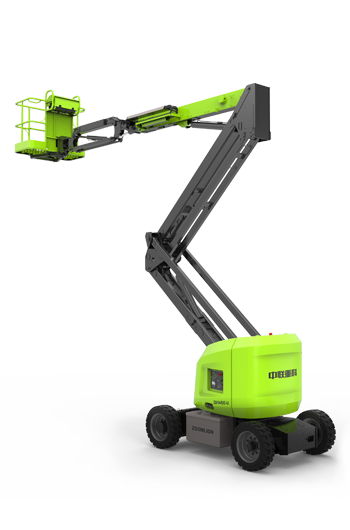
Planning the right access machine should begin with the job plan rather than a product brochure. An articulating boom lift may be suitable when work points vary in height, outreach, or direction, but procurement teams first need to map the task. Required height, horizontal reach, up-and-over access, platform load, ground conditions, obstacles, and travel routes all influence the specification.
Define the Work Position
Start by identifying the exact locations where workers need to stand and work. A simple elevation drawing can show whether the platform must approach from below, from the side, or over an obstacle. IPAF’s MEWP selection guidance recommends considering height, outreach, task requirements, environment, terrain, access, training, and supervision when selecting equipment.
The number of workers and the weight of tools or materials should also be established. These figures affect the required platform capacity and platform size. Describing the task with measurable values such as target platform height, required outreach, number of occupants, and maximum payload gives suppliers clearer information than simply requesting a “high” machine.
Measure Reach in Three Dimensions
Working height is only one part of an access requirement. Horizontal outreach determines how far the platform can move toward the work point, while up-and-over height helps establish whether the boom can pass above an obstacle. A machine that meets the vertical requirement may still fail to reach a façade, roof edge, pipe rack, or elevated installation area.
For an articulating boom lift, the work envelope should be checked against site drawings before ordering. Buyers should identify the required setup distance, side clearance, platform approach path, and areas where the boom could encounter beams, ceilings, pipework, equipment, or other fixed structures.
Account for Site Conditions
Ground conditions can change the practical suitability of a machine. Procurement teams should record whether the route includes concrete, compacted soil, slopes, uneven surfaces, temporary roads, or restricted areas. HSE guidance states that MEWP selection should consider the work and site conditions before use.
Wind is another important specification for outdoor work. Teams should confirm the machine’s permitted wind speed, maximum working slope, gradeability, and other operating limits that apply to the planned area. IPAF also identifies terrain, environment, restrictions, and delivery as factors that should be considered during MEWP selection.
Check Travel and Transport Requirements
The job plan should cover how the machine reaches the work area, not just how it performs once positioned. Record entrance widths, route heights, turning areas, overhead restrictions, storage space, and surface transitions. These measurements can determine whether the selected machine can be delivered and repositioned without major site changes.
Transport weight and stowed dimensions also matter. A machine may provide the desired reach but still exceed available transport capacity or encounter access restrictions at the site entrance. IPAF’s selection guidance specifically includes delivery among the factors that should influence equipment choice.
Specify the Working Envelope
Once the work positions are mapped, convert them into a procurement specification. Include minimum working height, minimum platform height, required horizontal outreach, up-and-over clearance, platform capacity, number of occupants, working slope, wind limit, drive requirements, and machine dimensions.
The objective is to avoid selecting from one headline figure. A complete working envelope gives suppliers enough information to identify an appropriate configuration and lets buyers compare quotations using consistent criteria. It can also prevent a late discovery that a machine reaches the required height but cannot position its platform at the actual work point.
Consider Controls and Operator Requirements
The machine should be matched with trained and familiarized operators and an appropriate safe-use plan. IPAF emphasizes selecting the correct MEWP, conducting a documented risk assessment, training and familiarizing operators, and establishing a recovery and rescue plan before work at height.
Planning should also identify overhead hazards, pedestrian interfaces, traffic movement, electrical risks, and potential trapping or crushing points. These considerations can influence the required machine geometry and operating position just as much as nominal height. Good planning therefore connects the job method, machine specification, operator competence, and site controls.
The ZA 14NJE-Li for a Defined Job Plan
The ZA 14NJE-Li from Zoomlion Access is specified as an electric articulating boom lift with a 16 m maximum working height and 14 m platform height. Its official specification lists 8.14 m horizontal outreach and 7.74 m up-and-over height. Platform capacity is 230 kg and gross weight is 6,700 kg.
The machine has a 6.5 m stowed length, 1.75 m stowed width, and 2 m stowed height. It also lists a 2.05 m wheelbase, 0.20 m ground clearance, 0.79 m inside turning radius, and 3.15 m outside turning radius. These figures can be checked directly against delivery routes, setup areas, and required work clearances.
Power and Operating Specifications
The ZA 14NJE-Li uses a 48V/315Ah lithium-ion battery and a 48V/60A charger. Its drive motor is listed as AC 32V/3.3 kW, while the lift motor is AC 32V/7 kW. Maximum drive speed is 5.4 km/h, gradeability is 30% or 17°, and maximum wind speed is 12.5 m/s.
Its specification also includes ±90° platform rotation, 360° non-continuous turntable swing, a 3/4° maximum working slope, and zero H-tail swing. The page identifies the model as CE/ANSI/CSA certified. Together, these figures provide procurement teams with measurable characteristics for checking whether the machine matches the planned work envelope and site conditions.
Evaluating Zoomlion Access Against the Specification
Zoomlion Access currently lists more than 100 MEWPs across five categories, including scissor lifts, telescopic boom lifts, articulating boom lifts, spider lifts, and telehandlers. Its articulating boom portfolio includes electric, diesel, and RT electric configurations, giving buyers different machine types to compare with varied task and environment requirements.
For contractors defining requirements before purchase, an articulating boom lift should be evaluated against the complete work envelope rather than maximum height alone. The ZA 14NJE-Li provides published values for working height, outreach, up-and-over clearance, capacity, dimensions, slope, and power. Zoomlion Access makes these specifications available for comparison with project drawings and site constraints.
