
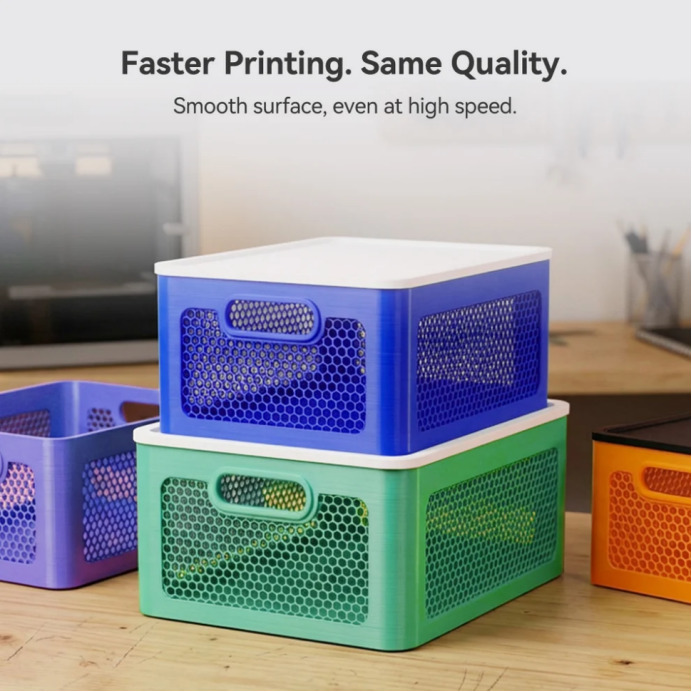
A standard 1.75mm spool can look identical on the outside, but the plastic inside behaves quite differently on a 3D printer. PLA offers sharp details and rigid structures, making it suitable for static models, architectural prototypes, and decorative items. PETG provides flexibility and moderate heat resistance, serving as a practical choice for durable, functional parts that need to withstand physical stress. Achieving a successful print involves matching these specific material characteristics with your printer’s hardware, slicer settings, and post-processing workflow. Mismatched parameters often lead to wasted filament and failed prints.
Extruder Mechanics and Thermal Demands
The hotend requires different conditions for each polymer. PLA melts smoothly between 200 and 220 °C, flowing predictably through standard brass nozzles. The extruder gears maintain a steady grip without requiring excessive torque. When running a high-quality 1.75mm 3D Printing Filament like PLA, the low backpressure supports faster print speeds.
SUNLU’s standard PETG filament has a recommended nozzle temperature of 240–260 °C, while specific formulations, such as PETG 2.0, may have different temperature requirements depending on printing speed. Its molten behavior also differs from PLA, so users should follow the recommended settings for their particular filament. This thicker melt clings to the nozzle walls, creating backpressure that forces the drive gears to work harder. A dual-drive metal extruder can help prevent filament grinding and under-extrusion. PETG also benefits from all-metal hotends to avoid PTFE tube degradation at these elevated temperatures, whereas PLA runs fine with standard PTFE-lined heat breaks. Using standard hotends at PETG temperatures can accelerate tube wear over time.
First-Layer Adhesion and Release Forces
The interaction between the polymer and the build plate shapes the preparation workflow. PLA adheres firmly to textured PEI sheets and glass at 50 to 60 °C. After the print finishes and the bed cools down, the part typically releases with minimal force, preserving the bottom surface. You do not need to apply excessive force to remove the print, and the bottom surface usually remains smooth.
PETG forms a strong chemical bond with bare glass at 70 to 80 °C. Removing a large PETG print from a warm glass bed increases the risk of chipping the surface or tearing PEI coatings. Applying a glue stick or specialized liquid as a release agent creates a protective barrier to prevent this issue. The first layer squish requires careful adjustment; a nozzle that is too close can drag through the viscous PETG, degrading the bottom finish and potentially clogging the extruder.
Printing Speed and Stringing Control
Achieving clean surfaces involves managing melt flow at different printing speeds. PLA solidifies quickly, allowing the part-cooling fan to freeze the outer walls effectively. Standard retraction distances can help manage filament movement during travel moves, although the optimal settings depend on the printer, extruder type, and filament characteristics.. The material maintains good dimensional stability during rapid directional changes. If the cooling fan is not running adequately, overhangs can sag and lose their sharp geometric definition.
PETG requires a slower approach to minimize surface defects. The polymer has a tendency to ooze from the nozzle, creating fine hair-like strings across the print. Calibrating higher retraction speeds and distances is advisable to manage this tackiness. Running a premium 1.75mm PLA Filament demonstrates how stable melt flow reduces stringing, whereas PETG often requires pressure advance tuning to maintain clean edges. Reducing the print speed helps the polymer cool adequately before the next layer is applied, minimizing blobs and surface artifacts.
Post-Processing and Surface Modification
Modifying the exterior requires distinct tools. PLA suits standard sanding, carving, and filling. Model makers favor PLA for armor and figurines because it sands predictably and holds primer well. Careful heat treatment can smooth edges, though prolonged exposure to a heat gun can warp the part and affect geometric accuracy.
PETG resists smooth sanding because its ductility causes abrasive paper to gum up rather than cut cleanly. Chemical smoothing requires specific solvents and adequate ventilation. Painting PETG demands adhesion promoters to reduce the chance of peeling during flexing. Testing a small coupon is helpful before committing to a full finishing batch. Aggressive sanding on PETG can generate enough friction to melt the plastic and smear the surface, potentially requiring a reprint.
Moisture Control and Material Storage
PLA and PETG can both absorb moisture from the surrounding air, although their moisture sensitivity differs. PLA generally absorbs less moisture than PETG under comparable conditions, while PETG may require more attention to humidity during storage. When exposed to moisture, either material can produce popping sounds, uneven extrusion, or surface defects during printing, potentially affecting layer bonding and print quality.
To reduce moisture exposure, keep unused filament in a sealed bag or airtight container with desiccant. Store spools in a cool, dry environment and avoid prolonged exposure to humid air. If a filament spool has absorbed moisture, drying it according to the manufacturer’s recommended temperature and duration may help restore more consistent printing performance. Labeling the opening date can also help users track storage time and manage filament inventory.
Sourcing filament from a reputable manufacturer like SUNLU can help users obtain more consistent material quality. Consistent filament diameter supports stable feeding and extrusion, which may reduce printing issues during longer jobs. However, the final print quality also depends on factors such as nozzle condition, temperature, printing speed, and slicer settings.
Choosing between these polymers depends on your specific design goals. PLA offers rigid visual prototypes with sharp details and simpler post-processing. PETG provides toughness for functional brackets and assemblies that need to endure mechanical stress. Selecting the appropriate polymer and matching it with suitable hardware and slicer settings helps achieve a smoother workflow and a reliable final part.
