
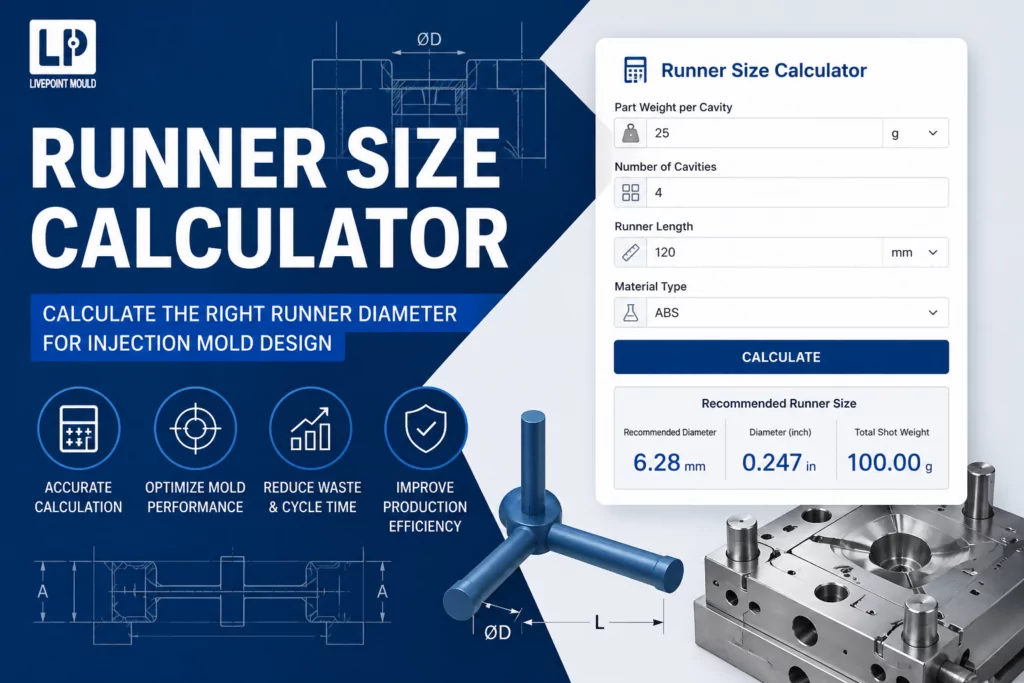
Injection mold tonnage calculation is a complex process influenced by multiple factors, and understanding these factors is essential for businesses to achieve accurate calculations. Incorrectly ignoring or underestimating these factors can lead to tonnage miscalculations, resulting in production defects, mold damage, and increased costs. This article explores the key factors affecting injection mold tonnage calculation, explains how the injection molding tonnage calculator incorporates these factors, and provides guidance for clients to improve the accuracy of their injection mold tonnage calculation.
Part and Mold Structural Factors
The structure of the part and mold is one of the most critical factors affecting injection mold tonnage calculation. The projected area of the part—calculated as the maximum cross-sectional area perpendicular to the injection direction—directly determines the base tonnage requirement. Larger projected areas require higher tonnage to counteract the pressure of molten plastic. Additionally, part complexity (e.g., deep cavities, thin walls, undercuts) increases the difficulty of tonnage calculation, as these features affect pressure distribution. For molds with multiple cavities, the total projected area is the sum of each cavity’s area, which significantly increases the required tonnage. Livepoint Tooling advises clients to carefully measure part and mold dimensions, as even small errors in projected area can lead to significant tonnage miscalculations. The injection molding tonnage calculator is designed to account for these structural factors, allowing users to input part and mold parameters to obtain accurate tonnage values.
Plastic Material and Process Factors
Plastic material properties and injection process parameters also play a key role in injection mold tonnage calculation. Different materials have distinct viscosity, density, and shrinkage rates, which affect the injection pressure required. For example, high-viscosity materials (e.g., PC, ABS) require higher injection pressure, increasing the required tonnage. Crystalline materials (e.g., PE, PP) have higher shrinkage rates, which can lead to uneven pressure distribution and require adjustments to tonnage calculations. Injection process parameters, such as mold temperature, injection speed, and holding pressure, also influence tonnage requirements—higher mold temperatures or injection speeds may increase the pressure exerted on the mold, requiring higher tonnage. The injection molding tonnage calculator integrates material databases and process parameter guidelines, helping clients select the correct injection pressure and adjust tonnage calculations accordingly. Livepoint Tooling further supports clients by providing material selection guidance, ensuring that tonnage calculations align with the chosen material’s properties.
Optimizing Tonnage Calculation by Addressing Key Factors
For businesses, optimizing injection mold tonnage calculation requires addressing all key factors systematically. First, ensure accurate measurement of part and mold dimensions to obtain the correct projected area. Second, select the appropriate plastic material and input its properties into the injection molding tonnage calculator. Third, adjust for process parameters and apply a reasonable safety factor to account for fluctuations. Livepoint Tooling’s injection molding tonnage calculator is designed to streamline this process, incorporating all key factors into its algorithm to deliver accurate results. By understanding these factors and leveraging the calculator effectively, businesses can reduce tonnage miscalculations, avoid production issues, and optimize their injection molding processes. This not only improves product quality but also reduces costs and enhances operational efficiency.
